










Richa Bajpai Disrupts Venture Capital with Student-Focused Approach, ETEntrepreneur
In venture capital, experience is usually a feature.
Richa Bajpai has built a fund around the opposite proposition.
The founder and CEO of Campus Fund believes there is something valuable about backing entrepreneurs before they have accumulated the credentials that traditionally make a founder easier to underwrite.
She knows because she was one of them.
“I started my first startup back in 2009 when I was in my final year of engineering. I started when I was 21 years old, and that too in 2009, when the ecosystem was just getting started,” Bajpai told ANDEntrepreneur.
She went on to start a second company, Goodera, in 2014, before stepping away from the business and returning to school. At London Business School, she came across Dorm Room Fund, the student-focused investment model created in the US, and began thinking about what an equivalent could look like in India.
Her experience became the foundation for Campus Fund, which she started in 2020. What began as a small experiment now is in its third fund, with a corpus of $100 million, focused on student, recent graduate and college dropout-led startups.
Betting before the track record
Campus Fund began with a roughly ₹7 crore first fund, which was deployed across 10 startups. Its second fund, launched in 2022, was around $10 million. Fund III is significantly larger, with more than $50 million committed at its first close and plans to back up to 60-80 startups over four years.
According to Bajpai, the earlier vehicles gave her too little time to build an institution because she was repeatedly returning to the market to raise the next fund.
“With Fund III, I wanted at least four to five years to be able to invest rather than just going out there to raise money,” she said. “Campus Fund is a fund, but we are a hardcore startup as well. Building takes time.”
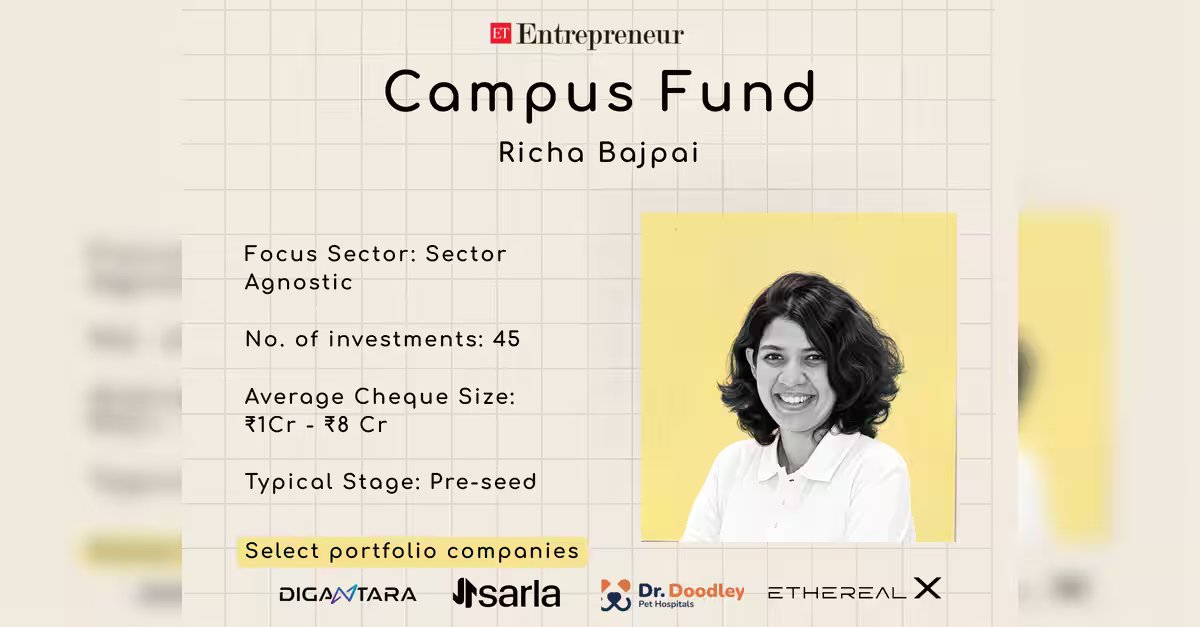
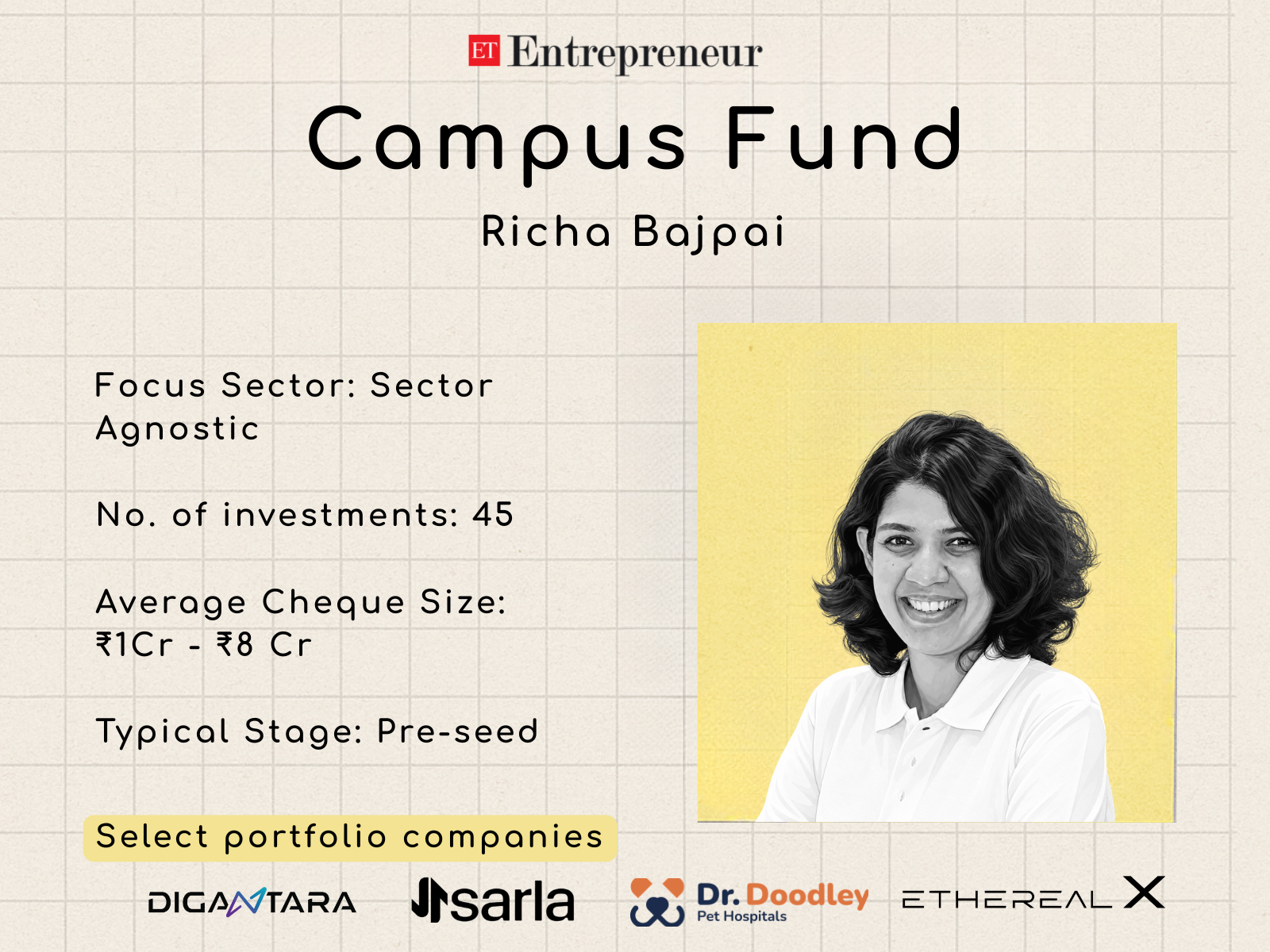
The larger corpus also gives Campus Fund the ability to follow on into its winners. Between 30 per cent and 50 per cent of Fund III is reserved for follow-on investments, Bajpai said, while the fund’s initial pre-seed strategy remains unchanged. Its initial cheque sizes remain between ₹1 crore and ₹8 crore.
The strategy remains deliberately sector agnostic.
“We are pre-seed investors,” Bajpai said. “I am looking to invest in companies which actually surprise us, especially in deeptech, which are pushing the boundaries of what’s possible before that has become a trend.”
Her internal test is simple enough: can the team build conviction that the company could reach roughly ₹1,000 crore in revenue in seven years?
“If that conviction comes to us, then we invest,” she said. “It really doesn’t matter which sector.”
That has produced a portfolio of 45 startups that ranges from space and deeptech to consumer technology, SaaS, genomics and pet care. Companies such as Digantara, EtherealX, Sarla Aviation and D-Nome sit alongside consumer-focused bets.
Looking for the deviation
If the sectors are not the filter, the founder becomes even more important.
Bajpai has developed what Campus Fund calls a founder’s ‘hustle quotient’, a deliberately unconventional way of assessing people who may have little conventional track record.
“In India, it is said that this is the straight road and you have to walk on this straight road,” she said. “We look at it differently. The higher the deviation from the straight road, the better entrepreneurial candidate you are.”
The idea is to look for evidence that someone has consistently stepped outside the prescribed path. Bajpai asks whether a founder has captained a sports team, raised money for a college fest or taken on responsibilities that required them to organise people and solve problems.
“There is a huge correlation when it comes to the hustle quotient,” she said.
It is also why she does not necessarily equate a prestigious university with founder potential.
Campus Fund’s portfolio includes founders educated at institutions such as Stanford, MIT, Harvard and Imperial College London. But Bajpai said the overall portfolio is more weighted towards non-Ivy League founders.
“I really don’t care about the pedigree that you have,” she said. “I care about Dhandawhether you can build the Dhanda or not.”
She is quick to note the fund will not avoid a founder from an elite institution, but her philosophy simply means the institution is not itself the investment thesis.
The advantage of being young
There is another reason Bajpai believes students make an interesting asset class: they have fewer preconceived limits.
“When you’re early in your life, if you were to build a once-in-a-lifetime sort of company, you need to be a little crazy,” she said. “The older you get, the more risk averse you become, and you get more coloured by the world.”
For Bajpai, that combination of blissful ignorance and low opportunity cost can become an advantage.
“You need a certain ignorance, plus craziness, plus no responsibility to go all out and build,” she said.
That also informs how Campus Fund works with its founders after investing.
Because the founders are so early, Bajpai believes the fund has a greater opportunity to shape the companies’ governance and operating culture.
“We have a very good opportunity to mould them right,” she said, pointing to the fund’s portfolio team and its regular founder interactions.
Young founders, she argues, also tend to carry a stronger sense of gratitude because someone has backed them before they have a track record.
“They operate from the plane of ‘I will not let you down because you believe in me,’” she said.
From India’s campuses to the world
The original Campus Fund thesis was about finding India’s next generation of student founders. That thesis is now becoming broader.
Earlier this month, Campus Fund earmarked up to $10 million from Fund III for its Build In India initiative, targeting students, recent graduates and college dropouts from anywhere in the world who choose to build from India.
The move followed a rise in the number of startups founded by students from international universities in Campus Fund’s pipeline. Such startups accounted for 7.1 per cent of the fund’s evaluated startups in 2025, up from 4.54 per cent in 2024, and 10.6 per cent of the startups evaluated in 2026 so far. Five of its last 10 investments have been in founders who studied abroad and subsequently came to India to build.
Bajpai sees the change as the result of several forces converging: AI, geopolitical uncertainty and the growing availability of capital and support in India.
“AI is a great advantage,” she said. “Second, the whole geopolitical thing that is happening. And third, just the kind of capital and support that this ecosystem is now providing in your own home.”
The thesis is also becoming more global in another way. In July, Howard Morgan, co-founder of First Round Capital, joined Campus Fund’s global advisory board. Morgan was involved in the creation of Dorm Room Fund in the US in 2012, the model that had influenced Bajpai years earlier.
For Bajpai, that connection brings the journey almost full circle.
She encountered the idea while she was a student in London. Six years later, she is running a $100 million institution around a similar conviction in India, while expanding the thesis to founders beyond the country’s borders.
“I had to go through this journey to be able to start Campus Fund,” she said of the path from founder to investor.
And perhaps that explains why she remains so invested in the category she chose.
“Entrepreneurship is the toughest thing that you would do to yourself,” Bajpai said. “It’s like self-inflicted pain.”













Post Comment