


There is something strange about the modern obsession with health data.
You can wear a smartwatch, track your sleep, count your steps, measure your recovery and still not know what to actually do with all that information.
Manavdeep Singh Grover, co-founder and CEO of SuperLiving, uses a Whoop himself. He isn’t entirely convinced it makes him healthier.
“It tells me so much data about me, which I should not be knowing,” he said. “Because now I am stressed about my own data. Why am I not sleeping?”
For Grover, that tension sits at the centre of what SuperLiving is trying to solve. Health, he believes, has become unnecessarily complicated. The average person does not necessarily need another dashboard telling them everything that is wrong.
The user SuperLiving is built around is perhaps dealing with persistent acidity, knee pain, low stamina, poor sleep, weight gain or stress, but not yet dealing with a serious chronic condition.
“We are not here to manage your diseases, we are here to prevent your diseases,” Grover said.
That idea sits behind the evolution of SuperLiving, a startup that began as something quite different from the AI health companion it is today.
From a solar EV to health content
Grover and his wife and co-founder, Gurjot Kaur, have tried entrepreneurship once before. In 2019, the two began building what they hoped would be India’s most affordable electric vehicle: a four-wheeler that could cost less than a two-wheeler.
They built a solar-charged EV designed around the realities of India’s middle- and lower-middle-class consumers. The startup went on to win the United Nations’ India and APAC finals and make it into the global top 10. Then COVID hit, followed by funding constraints, and the company could not continue.
“We always knew that if we get something good in future we would definitely jump onto that,” Grover said.
The two subsequently spent years at the likes of Amazon, Meesho and Pocket FM, working on products aimed at India’s mass market, particularly consumers outside the largest metros.
“We understood what makes them pay, what makes them stick to the system, why retention is good and how cross-category adoption works,” Grover said.
So when SuperLiving launched in July last year, it wasn’t an AI health company.
It was a content company.
The founders began producing health-focused micro-dramas. The idea was to teach through stories rather than lectures. One of the first series followed a housewife in a tier III town dealing with thyroid issues, menopause and stress at home.
“The whole story was a drama,” Grover said. “It was a housewife in tier III who had thyroid issues. She was also going through menopause and stress, and stress was caused by mother-in-law, husband, relatives.”
“The goal was that people understand how she managed it all, not who is the villain or who is the hero of the story.”
Because the company was bootstrapped, the founders first tested the idea on YouTube. They produced five shows, using actors, AI and themselves, and eventually reached around 36,000 subscribers without running ads.
That gave them enough confidence to build an app but exposed the limitation of content.
“If I am a thyroid patient, I will watch only thyroid series,” Grover said. “I don’t think this platform is meant for me for all other use cases.”
There was another problem. Even when the content was ostensibly relevant, the advice could fail to account for the user’s circumstances.
“If the person starts taking more protein, a high-quality whey supplement, I can’t afford it. So now I feel like, okay, this is not for me, this may be someone else.”
Users told the company they loved the content but could not stay for more than a month because there was nothing relevant for them to do after that.
That led to SuperLiving’s first major evolution.
“People need personalised support and long-term support,” Grover said.
The company began building an AI layer on top of its content.
From content to companion
The logic was simple. Content could tell people what healthy behaviour looked like. But changing behaviour required a guide that could understand the individual, track what they were doing, push them when necessary and adapt when something wasn’t working.
“For that either it has to be done by a human or an AI,” Grover said. “And we decided at that time that if you have to do it for the mass, you can’t put thousands of humans on the app.”
SuperLiving now has specialised AI companions across areas including nutrition, diet, fitness, skin, stress, hair and sexual wellness.
The reason for having multiple companions rather than one assistant is rooted in another lesson from the company’s early users: people don’t have one problem.
“It always starts with one which is something that is disturbing you the most,” Grover said.
He uses his own weight-loss journey as an example. Grover said he has lost around 18 kg over the past year, but weight was only one part of the problem. He also had issues with stamina, hair fall and stress. Stress contributed to overeating, which contributed to weight gain.
“You have to understand what’s the root cause,” he said.
The product therefore tries to introduce change gradually. A user might start by increasing water intake, then add walking, then introduce higher protein intake. The companion observes and adapts rather than dumping a long list of behavioural changes on someone on day one.
“If you really want a user to stick, there are two things that have to work out,” Grover said. “One, can I do one small change a day? And number two, can I get some early results which give me motivation that, okay, this is working for me?”
The AI is also designed to decide when to intervene.
“If you are a working person, it knows that you are in office, so it won’t disturb you,” he said. “Or it’ll only text you around lunchtime when you might be craving a sweet after lunch.”
But the more ambitious part of the system is its memory.
Grover said SuperLiving has spent significant time building its own memory systems and knowledge banks, rather than relying entirely on general-purpose models. The system is intended to understand what information about a user should be remembered, when it should be retrieved and when it should trigger an intervention.
The company also uses human experts to train and quality-check the companions. Nutritionists from different regions are involved because, as Grover puts it, “a North Indian nutritionist is not fit for a South Indian user.”
SuperLiving has built guardrails around areas such as prescriptions and severe mental-health situations. Grover said that when a user asks whether they should change or stop medication, the AI is designed to tell them it cannot do that. In cases involving suicidal thoughts, the company has partnered with a suicide helpline and wants the system to escalate rather than attempt to solve the problem itself.
“LLMs try to solve everything,” Grover said. “They feel like this is a task given to us. We should do it. But in our case it has to be no.”
There is another reason SuperLiving looks different from many healthtech products built around affluent, highly instrumented consumers.
Its users may not have the hardware.
“They don’t even have weighing machines at home,” Grover said of users in tier-III cities.
So SuperLiving has been building what Grover initially described as ‘AI-fed Indian jugaad’.
The company has built image-based tools to estimate things such as body composition and skin characteristics. Grover describes the approach as ‘jugaad’, though he argues that it is becoming more than that as the company tests these systems at scale.
“It was a jugaad, but now I think people love it because number one it builds habit.”
Grover said SuperLiving tells users that if they can afford a device, they should use one.
That thesis is now showing up in the company’s numbers.
SuperLiving said it has crossed 1.5 million app installs and more than 100,000 paying users, with 73 per cent of paying users coming from Tier II and Tier III cities and beyond. The company reached those numbers in less than a year after launch.
That is important because the company’s pitch to investors has always rested on a market many consumer-health businesses have struggled to crack.
“Every single round, we have got more nos than yes,” Grover said. “People always feel that India will not pay for health. India is not consistent for health, and tier III will never pay for health.”
The company has now raised $7 million in series A funding led by Lightspeed, with existing investors Kae Capital and All In Capital participating. Including its earlier rounds, SuperLiving has raised a little over $9 million.
The fresh capital is going toward deeper AI capabilities, vernacular content, product development and user acquisition in smaller cities. But Grover said the company is not treating the funding as an excuse to simply spend more on growth.
“What we are looking at today is that we want to launch the world’s best memory model,” he said. “We want to spend more time on R&D. We don’t want to be another consumer company where you are just using the best of LLMs and just selling the same in a different version to the user.”
From AI coach to health concierge
The AI companion, however, is not supposed to be the endpoint.
“The biggest picture is building the most personal AI health concierge,” Grover said.
Some of these agents are already being tested with a small percentage of users. Grover said they can make calls on behalf of users and return with the outcome.
Then there is the family.
SuperLiving is preparing a product called Super Family around another observation: health in India is often a family affair.
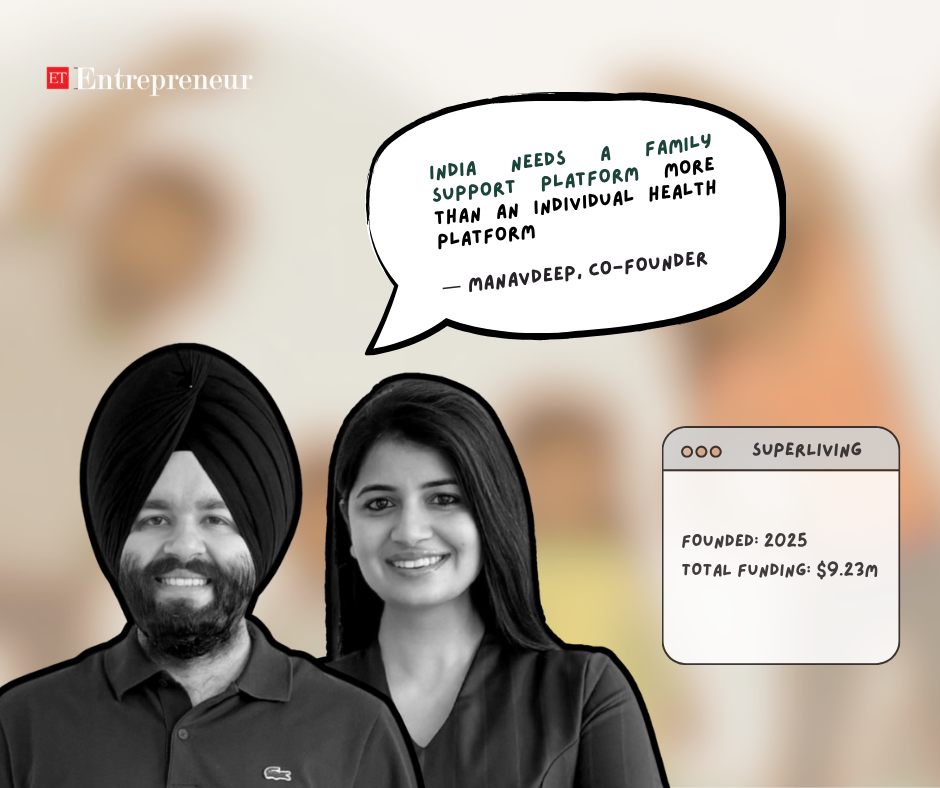
“India needs a family support platform more than an individual health platform,” Grover said.
A family might share meals and routines, parents might want to manage their children’s health or an NRI might want to understand how their parents in India are eating or what their latest blood tests show.
SuperLiving wants to build that context into the product.
The ambition is an attempt to build a system that knows the person, understands the family and eventually acts on their behalf.
But Grover’s most interesting description of the company’s ambition is also its simplest.
Health, he said, should become “as simple as brushing your teeth”.
“You don’t wake up every morning and debate whether brushing your teeth is worth doing. The behaviour is already muscle memory.”
SuperLiving wants to create the same instinct around health and it wants to sell that idea without frightening people into action.
“All the marketing around health has to be positive rather than fear marketing,” Grover said.