


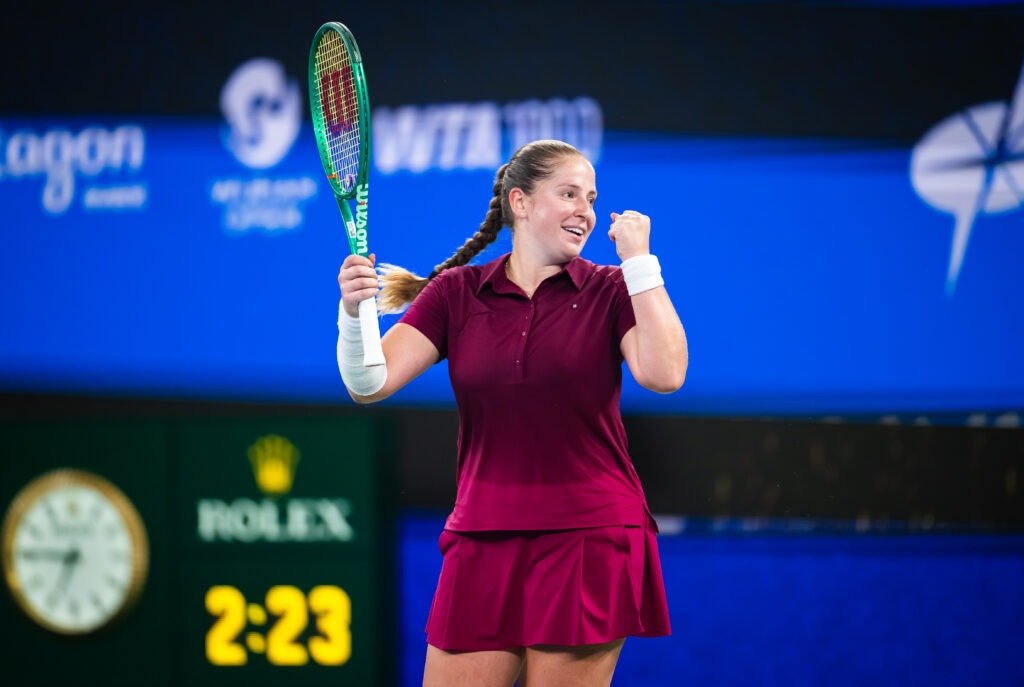
Jelena Ostapenko pulled off a thrilling turnaround in the Dongfeng • Voyah Wuhan Open second round, saving three match points in the second-set tiebreak to upset No. 2 seed and 2025 runner-up Jessica Pegula 2-6, 7-6(7), 6-3 in 2 hours and 23 minutes.
The result is Ostapenko’s third Top 10 win of 2026, and 28th of her career — and the first time she has beaten a Top 5 opponent since last year’s Stuttgart final, where she defeated Aryna Sabalenka 6-4, 6-1. It’s the third time that she’s defeated Pegula in seven meetings dating back to 2015, following her 3-6, 6-2, 7-6(3) win in the 2015 Québec City second round and her 6-4, 6-2 win in the Beijing second round. It’s also a revenge of sorts for her 2023 Doha loss, in which Pegula saved two match points for a 6-2, 2-6, 7-5 victory.
Ostapenko will next face either Leylah Fernandez or qualifier Shi Han as she bids to reach her third WTA 1000 quarterfinal of the season.
How did Ostapenko pull off the comeback?
As is often the case with Ostapenko, her ratio of winners to unforced errors can fluctuate from one extreme to the other with little warning. In the first set, she was barely able to stay in longer exchanges, winning just two points when the rally exceeded four shots and committing 11 unforced errors.
The 2017 Roland Garros champion’s form ticked up slightly at the setart of the second set, but Pegula kept her foot on the pedal to break for 3-2. Ostapenko received a medical timeout at this juncture and returned to court with her right arm heavily strapped.
“I had a lot of pain in my arm, then I took a painkiller and then I was fighting for every single point,” she explained in her on-court interview.
Her form continued to improve as the set drew on — but even so, Pegula’s strategy of giving nothing away enabled her to advance to three match points in the tiebreak. On the first, with the court wide open, the American netted a simple volley. Ostapenko found a service winner on her second serve to save the second, then came up with an audacious drop shot play to save the third.
Surging with confidence, Ostapenko roared through the decider with a scintillating display of her customary power tennis, finishing the match with 46 winners (including 10 aces) to 37 unforced errors (including 11 double faults). Her return of serve was particularly breathtaking — even when Ostapenko failed to convert a 30-0 lead when serving for the win, she simply recovered to break Pegula in the next game courtesy of two clean return winners.
It wasn’t just Ostapenko’s first strike that improved as the match went on, though. The Latvian won 23 rallies that went over four shots in the last two sets, including five that went over nine shots.
“The US swing was pretty bad for me,” Ostapenko said in her press conference (she went 0-3 in it). “After that, I feel like I was practising well at home. I feel I’m in the right zone now and I feel like I’m doing the right decisions. Sometimes when I have to go for the shots I’m going for it, sometimes — even when I play very aggressive — but today some points I was just trying to keep the ball in play and wait for the good ball to attack. I feel like I was doing this really good today, and yesterday, and also in Beijing.”
Anatomy of a hot shot: that drop shot down match point
The tried and trusted Ostapenko approach to tennis is to go with power at all times, and then with more power if necessary. Which is what makes her third match point save such a wild decision: after hammering the ball from side to side, unable to break through Pegula’s defenses, Ostapenko attempted a drop shot for the first and only time in the match. It landed perfectly for a winner, curving away from Pegula and cut too fine for even her wheels to reach.
What was she thinking? Asked about it afterwards, Ostapenko’s grin indicated she knew how unexpected a shot choice it had been.
“Honestly I don’t even want to think what I was thinking, because I think I was not thinking anything,” she said. “I was just in the moment. I think I play the best when I go by my — it’s funny to say, but with my instincts, with my feelings. I think you don’t really have to think what you are doing. Just be in the moment and play tennis.”
How many times has Ostapenko won from match point down?
This result is the seventh time that Ostapenko has won from match point down in a WTA main draw, and tied for the most match points she has saved en route to victory:
2016 Cincinnati R1, d. Anna Karolina Schmiedlova 1-6, 7-6(6), 7-6(5) — saved two
2017 Prague R2, d. Caroline Wozniacki 5-7, 6-3, 7-6(5) — saved one
2019 Charleston R2, d. Shelby Rogers 4-6, 6-3, 7-6(4) — saved one
2019 Linz SF, d. Ekaterina Alexandrova 1-6, 7-6(5), 7-5 — saved three
2022 Seoul R2, d. Anastasia Gasanova 6-3, 5-7, 7-5 — saved one
2024 Linz R2, d. Clara Tauson 3-6, 6-4, 7-6(7) — saved one
2026 Wuhan R2, d. Jessica Pegula 2-6, 7-6(7), 6-3 — saved three