


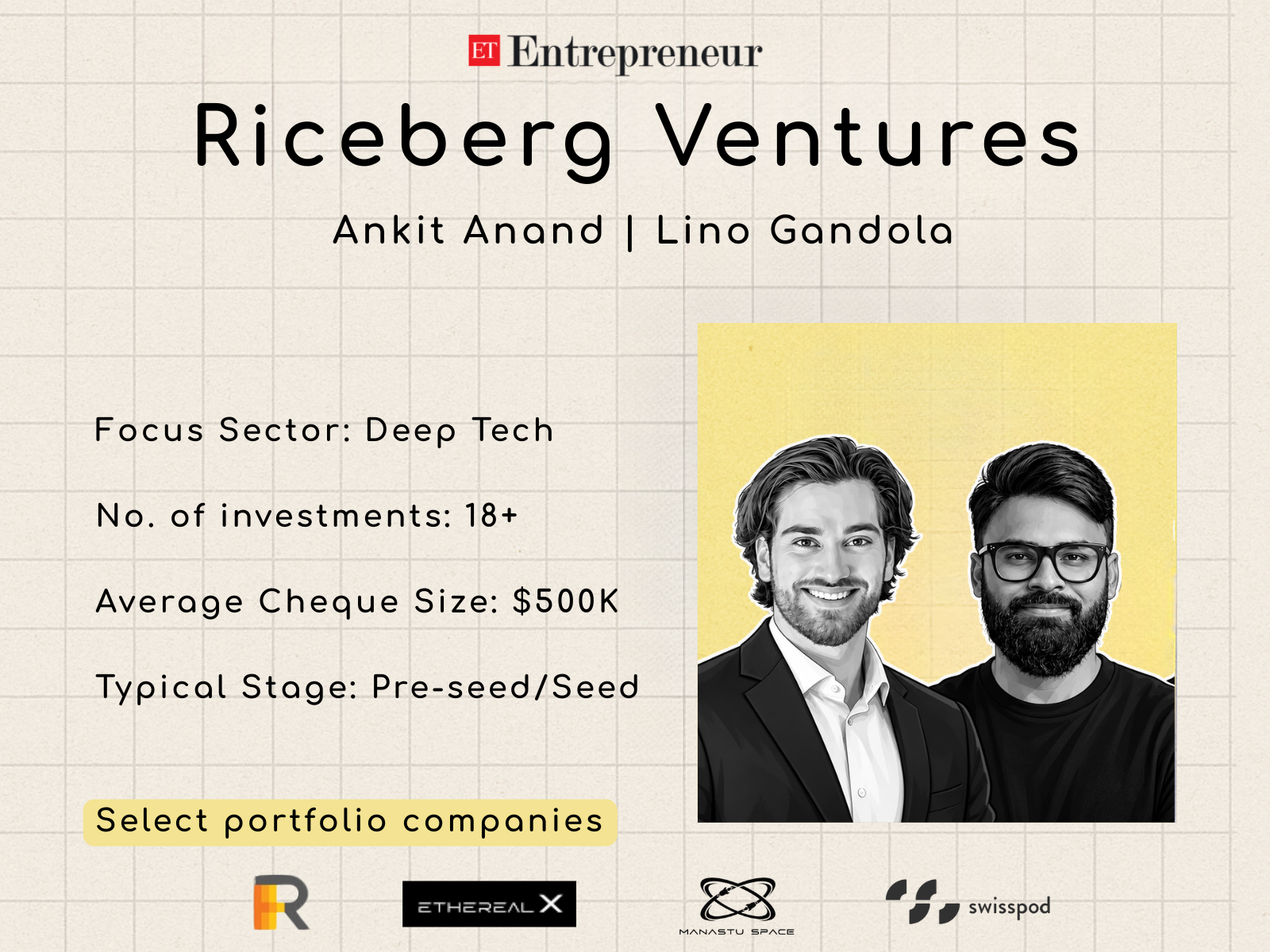
The idea behind Riceberg Ventures did not begin with a fund, an elaborate investment thesis, or a pitch deck. It started with a conversation about a spacetech startup that had already built a technology business but was struggling to get noticed.
The company was Manastu Space, an Indian startup developing satellite propulsion technology. When Ankit Anand first met the founders, he was surprised by how far they had progressed with relatively little capital. The company had already reached a high technology-readiness level, had contracts with international customers, and was working with DRDO.
The experience would become a defining moment for Riceberg Ventures, the global deeptech investment firm Anand co-founded. It also challenged his assumption that India lacked the appetite to fund frontier technology.
After Riceberg and another global investor came onto Manastu’s cap table, the startup’s planned seed round expanded from $2 million to $3 million and was quickly oversubscribed.
“That triggered a lot of people in the ecosystem in India. There is something that these guys are seeing that we are not seeing,” Anand said.
For Anand, the lesson was clear. Investors needed greater familiarity with frontier technologies and founders needed people who could help bridge the gap between scientific innovation and commercialisation.
“We realised that there is a risk appetite. People just don’t know where to start, and nobody is there to educate them on how this field works,” he said.
That realisation eventually pushed the group from angel investing into building Riceberg as a dedicated fund, and later into creating its own accelerator for spacetech founders, called KickSky Space Labs.
The venture capital firm has built a portfolio around early-stage breakthrough technology, with investments spanning Manastu Space, EtherealX, Signatur Biosciences, Keyron Medical and Arch0, among others. Its current portfolio lists 18 companies across six sectors and six countries, including spacetech, medtech, life sciences, energy, cybersecurity, future compute and AI/robotics.
In January 2025, Riceberg announced its $20 million debut fund, targeting 25-30 startups globally with an average cheque size of about $500,000. That approach has taken Riceberg beyond India. The firm has teams across Zurich, London, Boston, Amsterdam, and New York, with investments linked to technology and research ecosystems in different parts of the world.
A fund built around technological breakthroughs
Riceberg started as a group of founders and operators investing as angels. Its core thesis, Anand says, has remained consistent even as the fund has expanded geographically.
The firm is now more specific about what it means by deeptech. Rather than investing simply because a company operates in a technically complex sector, Riceberg looks for what Anand calls a ‘technological breakthrough,’ a technology capable of materially changing how an existing problem is solved.
“The first pillar is the breakthrough in technology. Then second is how big the market is. Third is how defensible it is,” Anand said.
Riceberg also conducts its own research into technological opportunities, rather than relying entirely on startups approaching the fund. The objective is to identify areas where a breakthrough could unlock a significant market and then assess which founders are capable of building it.
Why Riceberg built KickSky
As Riceberg began investing more heavily in Indian space technology, Anand saw another gap. India had scientists and technically capable founders, but many lacked experience in turning sophisticated research into products, selling to international customers, or raising capital from global investors.
That was the thinking behind KickSky Space Labs, the accelerator Anand co-founded in 2023 with E2MC Ventures.
For KickSky Space Labs, the accelerator has supported 11 startups across its first two cohorts, with six graduating and five subsequently raising institutional funding, while one was acquired. KickSky’s backers and partners have also outlined plans to deploy $10 million-$15 million into promising space tech startups globally.
“When we started to get excited about space in India, we soon hit the wall that there are great companies, but there are not a lot of Manastus,” Anand said.
The programme focuses on the transition from science to product, helping founders think through productisation, international customers, global investors and subsequent fundraising.
But Anand stressed that KickSky is not designed to manufacture entrepreneurs.
“We look for what we call entrepreneurial scientists, ” he said. “Entrepreneurship is something that comes from your core. You cannot teach entrepreneurship.”
A mentor, not a co-founder
Anand describes Riceberg’s role as being closer to a companion for founders than an operator inside their businesses.
“When I say I’m helping them go from science to product, I’m basically helping them as a companion to put their own thoughts into their work,” he said. “We are not doing the work, and we should not be doing the work.”
The support changes depending on the company’s stage. An early-stage founder might need help defining a product or business model, while a more mature startup could need introductions to global customers, investors, or support for its next funding round.
For Riceberg, that hands-on support is also part of its competitive advantage as an investor. Anand argues that VC firms should not measure success simply by their ability to identify promising founders.
“As a VC fund, you don’t win when you can choose the best founder. You win when the best founder chooses you,” he said.
From spacetech to the next frontier
Space was simply the first sector where Riceberg saw that gap clearly.
Anand is already thinking about what could come next, including ocean technology, a sector he believes could take years to develop into a major ecosystem.
“The whole idea of building at the frontier is that you don’t have to work on something that is already hot now. You have to start building something that is not hot now,” Anand said.
For Riceberg, the investment opportunity is therefore not limited to finding the next breakthrough startup. It is also about helping create the ecosystem in which those companies can emerge.
And if that ecosystem eventually becomes strong enough to operate without Riceberg’s intervention, Anand sees that as the ultimate sign that the job has been done.